Welcome back to another one of our Range Rants. Our initial rant was for our audience who already had a handgun optic. We talked about the battery life of a handful of the most common handgun optics out there and the importance of having a plan to change your optic battery to prevent failure when you need it most.
Today we will be covering optics for your handgun for those entertaining getting their first one, or, maybe another one…or two or three. Whether you already have an optic or not we’re sure you’ve heard of different terms for them that probably mean the same thing. Common names for non-magnified, illuminated aiming devices for handguns are RDS, or reflex sights, often broadly referred to as “optics” or “glass”. You may also hear them referred to by brand names, such as “ACRO” (AimPoint), “RMR” (Ruggedized Miniature Reflex) or “Tri” (Trijicon) and “Holo” (Holosun).
There are some particulars to each type which we will cover going forward. Today’s rant may not answer the question of are they for you (or not), or which one to buy if they are. What this rant will do is hit the wave tops of a few of the particulars to point you in the right direction. Some of the things to think about:
Closed / Sealed vs Open Emitter
Reticles Types
Reticle Colors
Reticle Size
Co Witnessing Irons and Optic
Other Concerns and Considerations
Closed / Sealed vs Open Emitter
Closed emitter handgun optics like the Aimpoint ACRO or Holosun 509T being two good examples are generally better if you carry in harsh, unpredictable environments. A sealed emitter might be your best bet because they protect the emitter from mud, snow, and debris. Open emitters like the Trijicon RMR or Holosun 507 are better for concealed carry and competition due to their lighter weight and smaller footprint.
Key Considerations
- Closed (Enclosed) Emitters:
- Pros: Superior reliability in rain, snow, and dust; more robust against impacts.
- Cons: Higher cost and generally heavier/bulkier. Beauty is in the eye of the beholder but sealed emitters tend to look like a ‘box’ sitting on your slide.
- Best For: Duty, harsh-weather and users prioritizing maximum ruggedness.
- Open Emitters:
- Pros: Smaller, lighter, generally less expensive, wider field of view, faster acquisition.
- Cons: Vulnerable to debris clogging the emitter, potentially obscuring the dot.
- Best For: Concealed carry, competition, and general range use.
Which is “Better”?
If you carry in challenging conditions (rain, snow, mud) or need maximum durability, a closed emitter is superior. If you want a lightweight, sleek, and less expensive concealed carry option and aren’t constantly in the elements, an open emitter is usually preferred.
Reticle Types
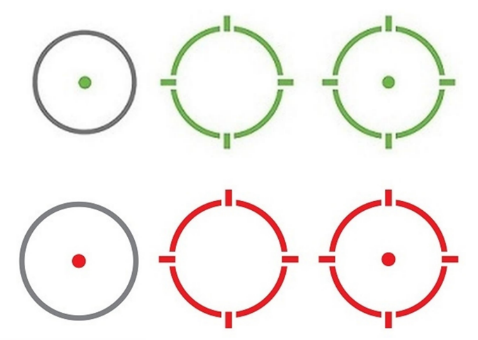
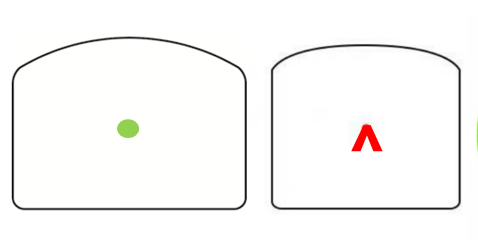
Handgun optic reticles feature an illuminated dot. Besides the simple dot options include a dot with a ring around it, a ring with no dot or a chevron (upside down ‘V’) instead of a dot. Some manufacturers like Holosun offer a Multi Reticle System (MRS) on some of their optics which allows the user to set the reticle to their preference.
A few manufacturers offer a chevron which incorporates an alignment ring like the Primary Arms ACSS (Advanced Combined Sighting System) Vulcan.
Types of Reticles and Colors
Reticle Colors
Besides the standard red illuminated reticle, the common alternative color for pistol optic reticles is green. For users with red-green color blindness, or simply due to preference, gold/amber might also be an option depending on the manufacturer. Some key details:
- Red: Pretty much all manufacturers have red as a color option for all the models they offer. Red is superior for low-light, dawn/dusk, or night conditions due to higher contrast against dark backgrounds.
- Green: Green light triggers more cone receptors in the eye, making it more visible than red in daylight conditions.
- Gold/Amber: This may be the best option for shooters with a certain color blindness and it provides high visibility in varied lighting conditions.
Reticle Size
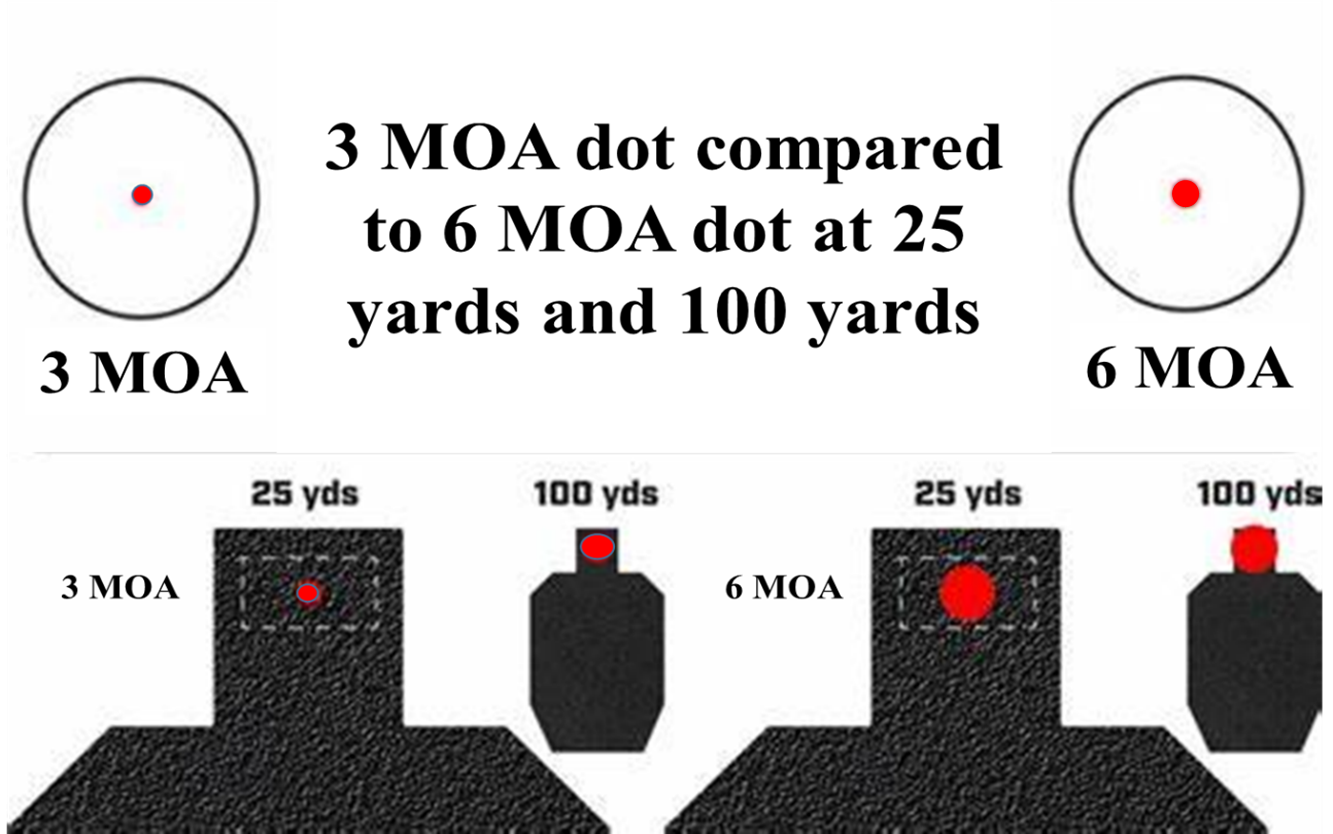
A Minute of Angle (MOA) is used to reference the size of the dot or ring on most handgun and rifle optics as it relates to a target or point on a target at 100 yards. A MOA is also a measurement that can be applied to both the adjustments of your optic and the size of your reticle.
Handgun optic dot sizes typically range from 1 to 8 MOA. Common handgun reticle sizes and types
- Single Dot (Most Common): A simple, solid dot ranging from 1 to 8 MOA. Size being relative, smaller dots are better for precision, while larger dots are preferred for speed and concealed carry.
- Ring-Dot: A central dot surrounded by a larger ring (usually 32–65 MOA). The ring assists with faster target acquisition, while the dot allows for precision.
- Chevron: A triangle or chevron shape that provides a sharp, tapered tip for precise aiming while being easy to pick up quickly.
- ACSS Vulcan: A specialized reticle (e.g., from Primary Arms) that features a central chevron or dot with a large, surrounding, non-visible circle. The outer circle only appears when the user is not perfectly aligned behind the optic, guiding them to bring the dot into view faster.
Key Consideration
MOA Size: A smaller Minutes of Angle (MOA) dot is more precise but harder to pick up quickly. A larger MOA dot is faster to find but covers more of the target.
Cowitnessing Irons and Optic
Cowitnessing refers to the relationship between the optic on your handgun and the iron sights. When the reticle of the optic aligns with the iron sights, the two work together as cowitness sights. Handgun iron sights allow you to have a reference point for your optic, and they also give you a contingency to use your iron sights if your optic stops working.
Typically iron sights can be cowitnessed at either “absolute” or 1/3 cowitness. It is possible, in some cases, to have less than 1/3 cowitness in order to keep the iron sights as far out of the way as possible which allows for a better unobstructed view of the dot while still providing a backup option if the optic fails.
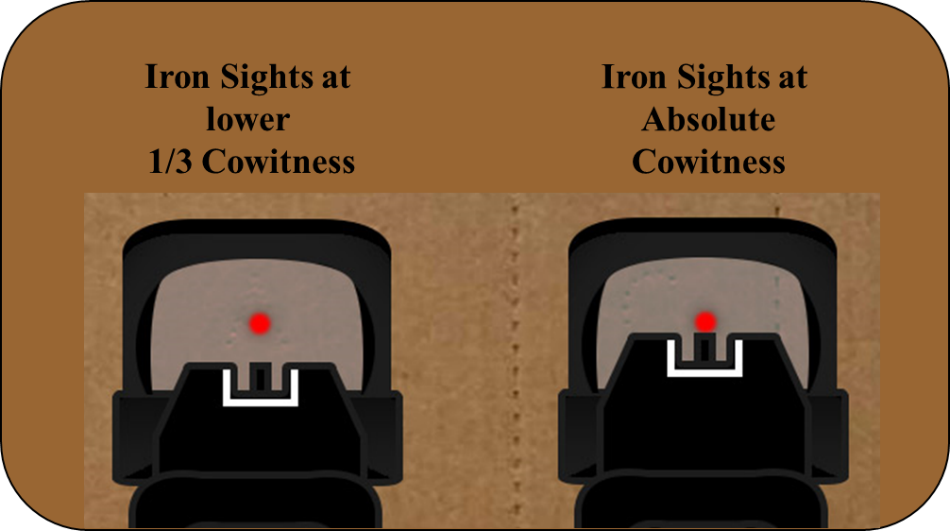
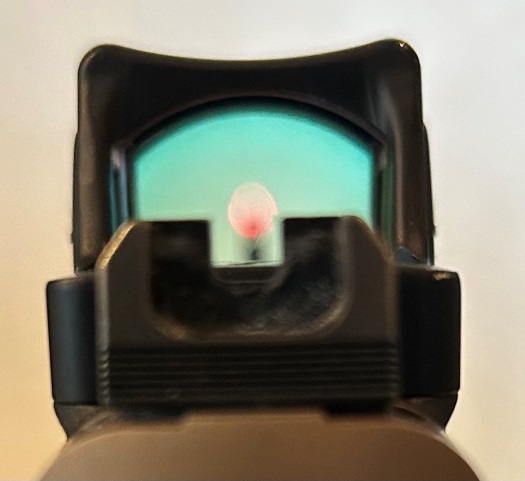
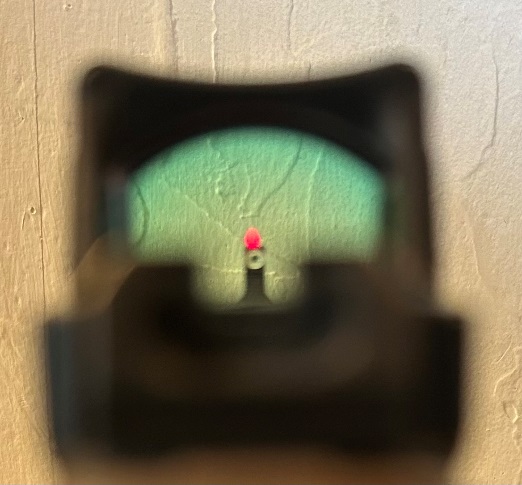
FN509 with Trijicon RMR (open emitter) with 3.25 MOA red dot. Iron sights at absolute co-witness.
Do I even need back up iron sights? Though most would say it would be prudent I would say it is user’s preference. My two cents: If your optic has a top or side load battery where you don’t have to take the optic off the slide in order to change it (a bottom load battery) and, accounting for usage, you have a maintenance schedule where you change the battery in timely intervals you will be fine.
The one caveat to going without having some type of back up irons on your handgun is if the handgun is also used for duty purposes you need to ensure you know your department’s policy concerning this. Remember the question I asked in my initial Range Rant, “So are you really going to trust your life to a watch battery?” There is no right or wrong answer as long as you have context to help make an informed decision.
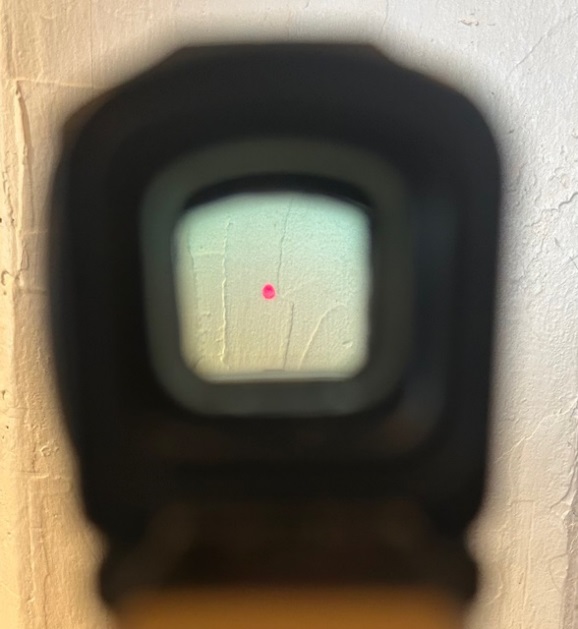
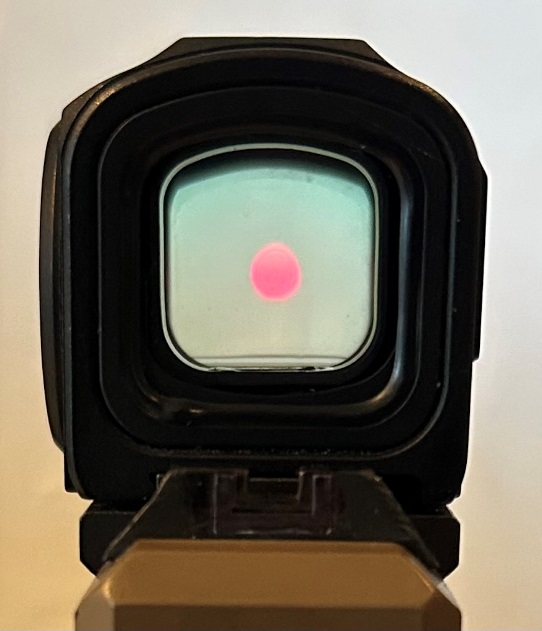
Glock 19X with Aimpoint ACRO P2 (sealed emitter) with 3.5 MOA red dot. No co-witnessed iron sights.
The option that works best may depend on what you find most convenient and comfortable and adheres to departmental policy if you are law enforcement.
Other Concerns and Considerations
Shooters Visual Acuity / Astigmatism
Astigmatism restricts the effective use of a majority of handgun optics, causing the reticle to appear as a blurry, starbursted, plume0d, or splotchy image rather than a crisp dot.
Before you buy any handgun optic, unless you already know, find out by trying out a red dot to find out if you have an astigmatism. If you have an astigmatism try out a green dot as some shooters have had a much better experience using green compared to red.
Environmental and Technical Constraints
If you are outdoors you’ll notice that intense sunlight can “wash out” the dot, making it nearly invisible, even with brightness settings turned up. As with anything that relies on a power source to work if you aren’t aware of how many hours (months/years) the optic is rated at and don’t have some sort of schedule to change the battery an unexpected power loss renders them useless.
Mounting Restrictions
If you have a suppressor take in to account, ahead of time, that it may obscure the red dot. This issue may require a specific suppressor-height optic and, or, a spacer plate to elevate the optic.
Saved Round
I have handguns with just iron sights, I have handguns with optics and irons and I have handguns with just an optic. It will be up to you to figure out if you should get an optic and what options it will have based on what works for you. Our overall concerns and considerations for or against:
Pros:
- Faster and Accurate: Optics allow for rapid target acquisition and improved accuracy at various distances compared to iron sights.
- Target-Focused: Unlike with iron sights where you are “front sight focused” you can focus on the target / threat and just superimpose the reticle on what you intend to hit.
- Better for Aging Eyes: Over time you lose visual acuity so if you have trouble focusing on traditional iron sights, an optic provides a clearer sight picture.
Cons:
- Cost: Quality optics aren’t inexpensive. “Buy once, cry once”.
- Learning Curve: It takes time and practice to become proficient with an optic starting out but if you’re already dry firing, like you should, the addition of an optic will not make the learning curve steep at all.
- Battery Dependence: Optics do rely on batteries, but some have a solar back up and ‘sleep’ type mode where the optic powers down or shuts off until the handgun is moved.
The Range is Cold
Adding an optic will not compensate for a shooter lacking in the fundamentals so if this article piqued your interest and you have a solid foundation with iron sights already an optic will be ‘value added’ for sure.
We hope you enjoyed this ‘rant’ and maybe learned something new for consideration. No doubt you may have more questions and if so please reach out. Be safe out there and see you at the store and at the range.
DARREN A. BRITTO
TRAINING DIVISION MNGR
SILVERBACK TRAINING SYSTEMS
SILVERBACK INDEPENDENT, LLC